Finding her voice through Nepal’s traditional Mithila art
Jyoti Sada’s family lost everything when a job agent scammed them. Years later, the drawings she once scattered across her village home’s walls have become her own way out, earning her income, independence and a stage to show other Nepali girls they can do the same.
WHEN I WALKED into the souvenir shop at Cultural Village, Jyoti didn’t notice me at first.
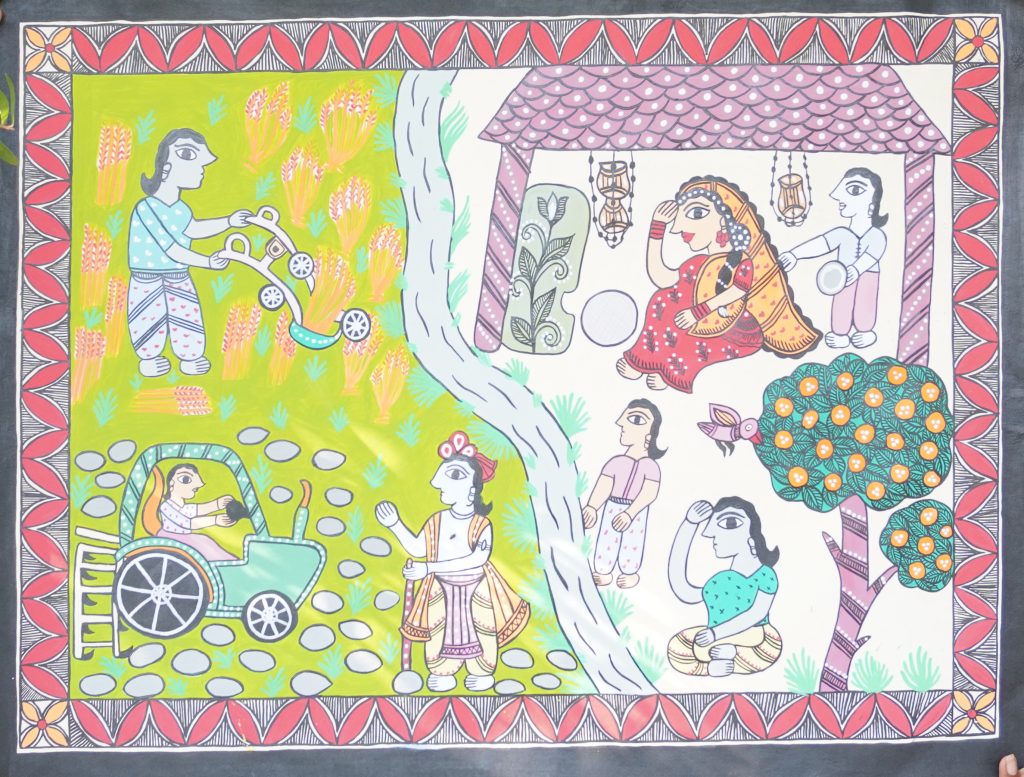
She was bent over a canvas, pencil in her hand, drawing a school. Paint brushes and colours were scattered on her right side. On the canvas, a teacher stood outside the school with children sitting around, books in their hands. On the other side, a mother was fixing her child’s hair to send the child off to school.
When Jyoti finally noticed my presence and looked up, she smiled, stood up quickly and folded her hands: “Namaste!” Her smile was shy and humble.
I introduced myself and asked her if she would be willing to share her journey to becoming a Mithila painter in front of 70 – 80 strangers.
Without a pause or a flinch, she said, “I would love to!”
A family undone by a scam
Jyoti Sada, eldest of four children, is 20 years old. Her father wanted a better life for his family. He sold everything they had, including land, and tried to travel to the Middle East for work. But his dream of going abroad disappeared when he was scammed by an agent. The family had nothing left, except hope for a better life.
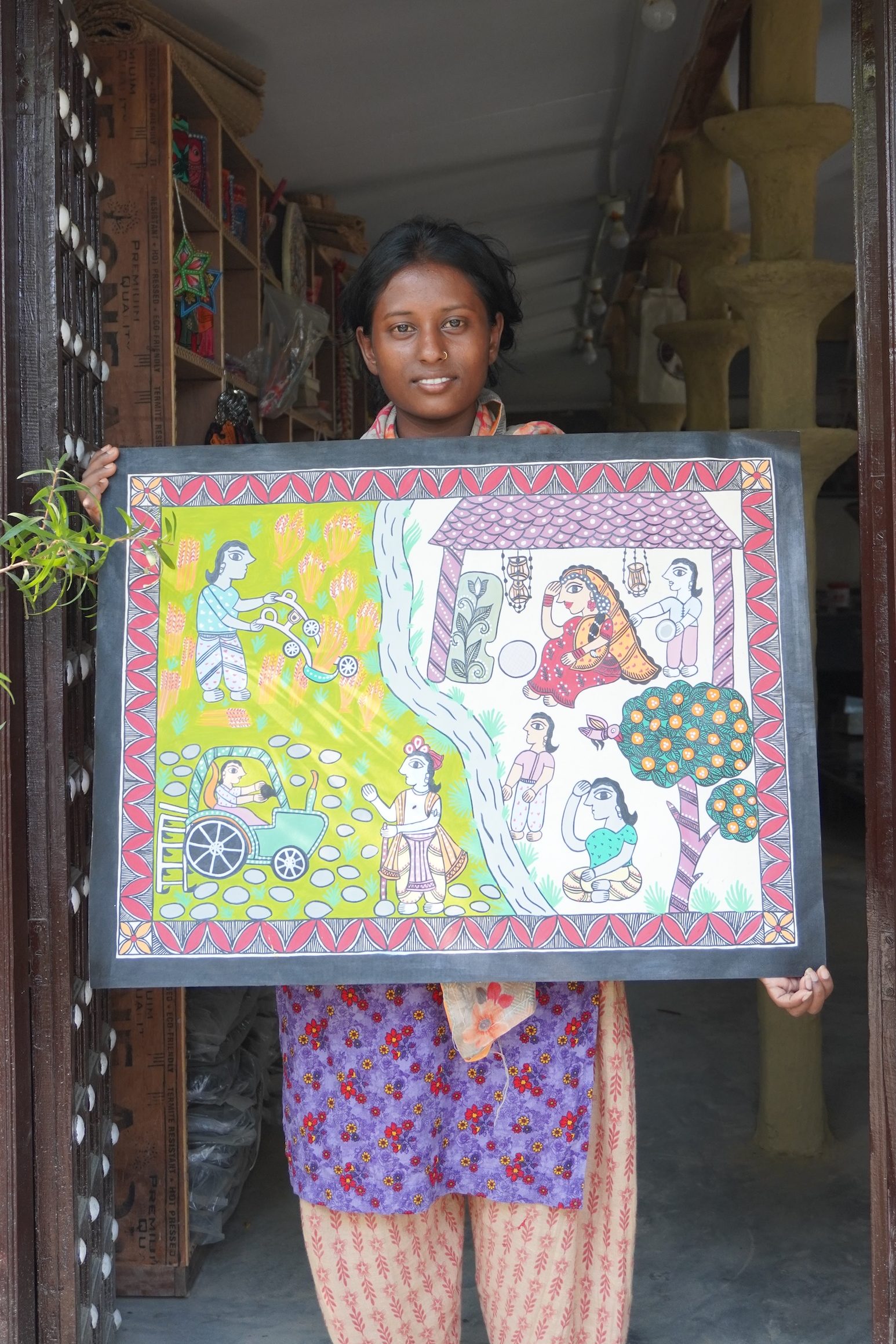
That incident led to Jyoti growing up faster than her siblings. She was the eldest and responsibility weighed her down before she fully enjoyed her childhood. Despite the increased burdens of family life, Jyoti passed secondary school. She held on to one thing that had always been dear to her since her childhood: drawing. She drew whatever caught her eye; she drew and painted everywhere – even on the walls of her house.
One day, someone noticed her painting on the exterior wall of her house in the village. They told her about an opportunity to formally learn Mithila painting at Cultural Village, a cultural tourism space in Janakpurdham, Madhesh, southern Terai region in Nepal.
She said yes without thinking twice.
The history behind Mithila painting
Mithila art is one of the oldest art forms of Mithila region in Nepal’s Southern Terai region. Legends say that the painting’s history dates back to the time of King Janak in Ramayana, a Sanskrit-language epic of the South-Asian region. It is said that King Janak ordered artists to decorate his kingdom (Mithila) for the wedding of his daughter Sita.
That is how women began painting the walls and floors of their houses during festivals and weddings with natural dye like turmeric, sandalwood, indigo plant, and other organic materials. They used fingers and twigs to create scenes depicting daily lives and rituals like marriage and other important festivals. Today, Mithila painting has become a source of income and recognition for many women in Mithila region and women have adapted canvas alongside traditional walls and floors.
The training gave Jyoti an opportunity to learn and grow. She even got a job there as a Mithila painter. For the first time, her art wasn’t just something she did; it was something she was paid for. The job even allowed her to go back to school and move to the higher secondary level. She’s now moving towards the future that until now had only appeared in her paintings.
It has not been an easy road. Cultural Village was an hour away from her home. Her parents didn’t want her travelling everyday an hour away for work alone. “It’s not appropriate for a girl your age to go outside the house and work like this,” her father told her.
Earning a living, one painting at a time
Things changed, albeit slowly, when Jyoti started earning through her paintings and contributing to the household. Her family began to see her work differently. Particularly her father, who had once worried about her travelling alone and working outside the home, saw the difference her income was making. It couldn’t support the entire family, but he saw that she was taking care of herself and her siblings in whatever way she could. Neighbours also started praising her achievements and even pointed to her as an example to their own daughters.
Back to today and my offer to Jyoti.
When she agreed to my invitation to share her story at the kick-off meeting of the Voices of Change project led by FCA Nepal, her friend looked at her surprised. “Aren’t you afraid?” she asked. “Can you speak in front of so many people?”
Jyoti looked at her and said, “How will I ever grow if I’m uncomfortable sharing my own story? How will I move forward if I don’t take the opportunities that come knocking on my door?”
Standing at the podium at the kick-off meeting, Jyoti shared her dream future with the audience: “I want to become a Mithila Arts teacher. I want to teach girls like me to paint and to earn their own living so that they can be independent.”
Jyoti was drawing a school when I first saw her.
On that day, I understood why.
Jyoti’s story is one of many the Voices of Change project aims to support. Funded by the European Union and led by FCA Nepal in partnership with Dalit Lives Matter Global Alliance and Shanta Foundation, the project aims to support young marginalized youth in building creative skills, confidence and economic independence to shape their own future.
—
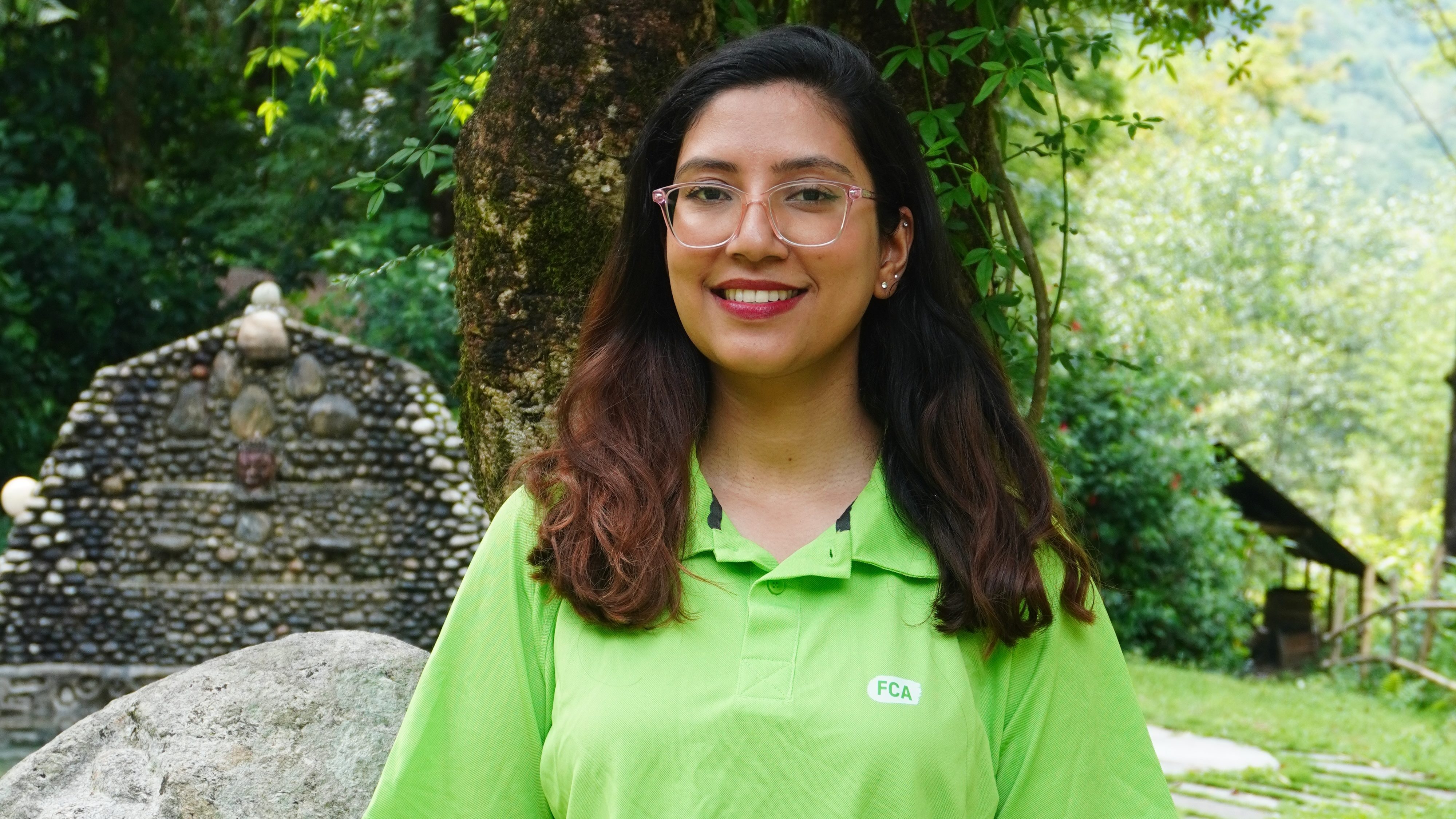
This blog was written by FCA Nepal’s Neha Sharma, who oversees FCA’s contribution to the EU-funded Voices of Change project.