A refugee in Uganda found her footing,
then helped others find theirs
Uganda hosts two million refugees, the most of any country in Africa, while international funding for the response has collapsed to a fraction of what is needed. In Rwamwanja settlement, one woman’s experience illustrates how support for refugees brings life-changing impact for them and those around them.
Text: Linda Kabuzire. Photos: Patrick Kyokolera.
“I am a single mother. I know the pain of struggling alone. I know what it means to look at your child and not know what you will feed them.”
MICHELINE USIA is a business owner, a mother and a mentor. She’s also a refugee, living in Uganda’s Rwamwanja refugee settlement.
Seven years ago, Micheline was a second-year university student in the DRC when she decided to leave. It was April 2019, and the violence linked to armed groups including the M23 rebels had made staying untenable.
“I didn’t tell my parents or siblings I was leaving. I just knew I needed peace. I told myself I would figure everything else later.”
She arrived at Rwamwanja Refugee Settlement in western Uganda, in Kamwenge district, and spent the first years focused on survival.
“Some days, I went hungry. I had no income, no plan, just surviving each day as it came.”
In 2021 she found work as a Child Protection Facilitator on a project that gave her some stability. When that project ended in April 2024, she was again without income, this time with a child and three siblings who had since joined her.
“When it ended, I felt lost. I had a child, responsibilities, and no income again. It felt like going back to zero.”
Uganda’s ‘open-door’ policy for refugees and why it’s under pressure
Uganda’s approach to displacement is, on paper, one of the most generous in the world. Its Refugee Act grants people fleeing conflict the right to work, freedom of movement, and access to public services including schools and health centres. New arrivals in settlements are allocated a small plot of land. This policy, sometimes called an open-door model, has made Uganda a reference point for international discussions about how to manage forced displacement as a development issue rather than a purely humanitarian one.
At the same time, international funding for the response has dropped sharply. By mid-2025, UNHCR’s Uganda budget was running at 28 per cent of what was required. The estimated cost of meeting one refugee’s basic needs stands at around 16 US dollars per month; without additional funding, the UNHCR warned it could deliver only 5 US dollars.
The evidence that skills and economic inclusion reduce long-term aid dependency is strong. Joint research from UNHCR and The World Bank has found that allowing refugees to fully participate in a formal economy can reduce needed international assistance by close to half, but that transition takes time and investment. Both are currently in short supply.
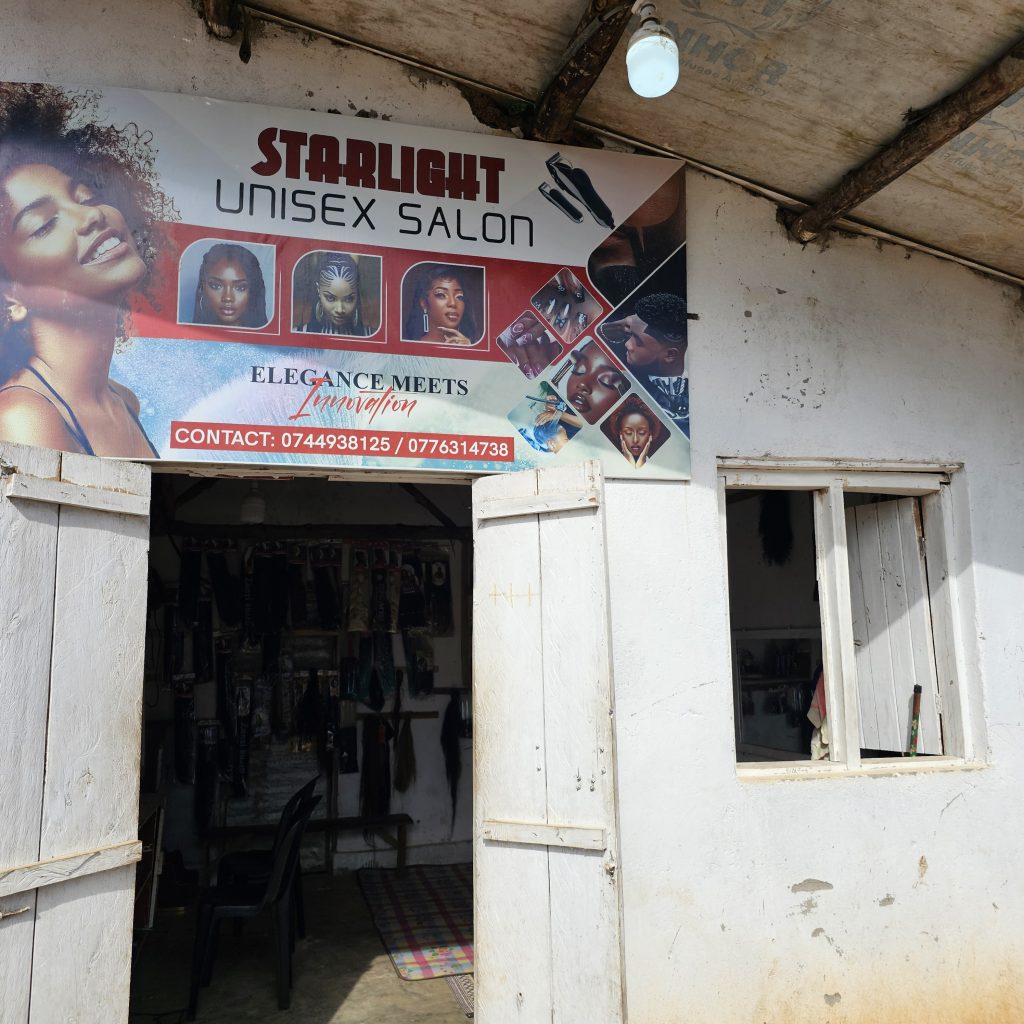
From a skills course, Micheline built a salon business in a refugee settlement
In September 2024, Micheline enrolled in a hairdressing and cosmetology course through the RETI Programme (Refugee and Host Community Youth Empowerment and Transformation Initiative) implemented by Finn Church Aid (FCA) and supported by the Mastercard Foundation. She heard about it from an announcement truck passing through Rwamwanja and went to the FCA office to ask more.
FCA has worked in Uganda since 2014 working across education, livelihoods, and peace. In Rwamwanja specifically, FCA has run vocational training programmes for Congolese refugees and host community members across trades including tailoring, construction, welding and salon work with the consistent aim of linking training to employment or self-employment.
The RETI programme extends that approach across 15 refugee-hosting districts, targeting young people aged 15 to 35, with a particular focus on young women.
For Micheline, the training produced a shift in how she approached her situation.
“The training changed how I think. I didn’t just learn to do hair. I learned how to think like a businesswoman.”
After completing the course, she borrowed UGX 500,000 (about 116 euros) from a savings and lending group, opened a small salon, and bought initial supplies. Business was slow at the start. In May 2025, she received an innovation grant of the same value from the RETI programme, which she used to move to a better location, buy equipment, and present the salon more professionally.
“That support came at the right time. It helped me move to a better location, buy machines, and make my salon look professional.”
The salon now serves both women and men, and Micheline also offers mobile services for clients who cannot come to her.
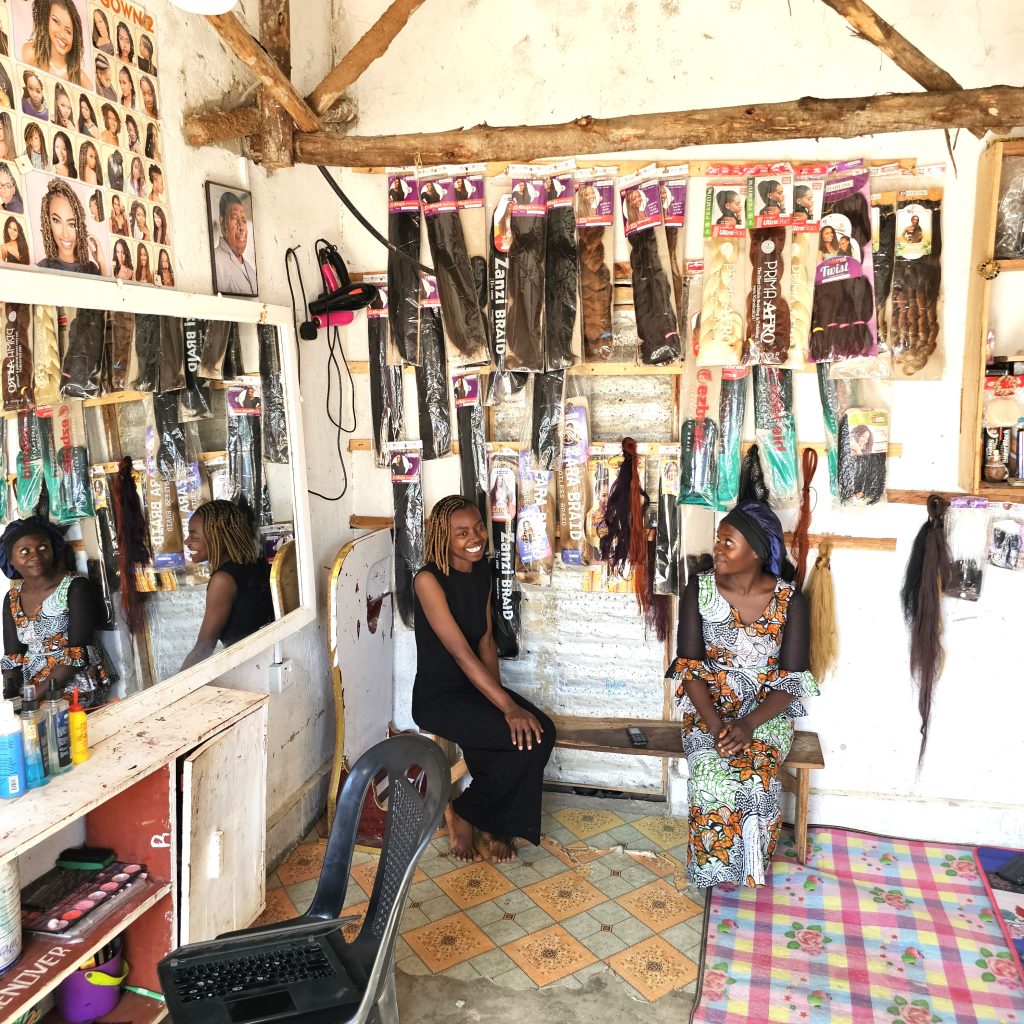
How Micheline is employing other single mothers in Rwamwanja
As her business steadied, Micheline began looking at the people around her.
One neighbour, Neema Mitima, was struggling to care for her two children. Usia approached her not with advice but with a practical offer: come and learn a skill.
“I told her, ‘Come, let me show you something. You can do this. You don’t have to remain like this.’”
By mid-2025, Micheline had trained four single mothers in hairdressing. She has continued taking on more when they come. The arrangement is practical: women who do not yet have capital to start their own work can earn from the salon while they build experience, taking a share of each client payment. Those trained by Usia also join mobile salon work, going to where clients are.
“If a client pays UGX 5,000 (1.15 euros) for washing hair, I give them UGX 2,000 (0.46 euros). It may seem small, but for them, it means food for their children.”
‘I am not the same person’: what vocational training for refugee women actually changes
Neema Mitima is 22 years old. Before she met Micheline, she had no income and no clear path to one.
“When I met Micheline, I had nothing. I was struggling with my two children, and no one was willing to help me.”
Micheline taught her how to braid hair and how to work with clients. Neema now earns money from the salon, uses it to buy food for her children, and describes the change in plain terms.
“Before, I didn’t think I could do anything. Now I believe I can do something with my life. I am not the same person I was before. Micheline is my inspiration. She didn’t just help me, she showed me a different way to live.”
The progress Micheline has made is real, but it sits inside a system under strain. The funding shortfalls affecting Uganda’s refugee response are not abstract: they show up in reduced food rations, closed health facilities and school dropouts. The IRC reported that by early 2026 more than six disease outbreaks had occurred in refugee settlements across Uganda in the previous year, while medicine shortages were crippling facilities’ ability to provide care. Malnutrition in children had risen from 5.4 to 7.8 percent across most of Uganda’s refugee locations.
Micheline sees the challenges in her immediate community too. Some of the women she trains lose momentum. Attendance is inconsistent. Materials are limited. “Sometimes they lose hope. Sometimes they don’t come regularly. But I tell them, ‘Look at me. I started like you. If I did it, you can also do it.’”
What happens to refugee self-reliance when funding runs out
Micheline’s immediate plan is to open a second branch in Katalyeba town and reach more people, including members of the host community. She supports her child and three siblings. The trajectory of her situation, from arriving with nothing in 2019, to running a business and training others in 2025, is precisely the kind of outcome that Uganda’s model is designed to produce.
“Before, I depended on others. Now, others depend on me. And I am able.”
Uganda’s policy gives people the legal right to work and build a life. Programmes like RETI provide the skills and start-up capital to make that right usable. But both depend on sustained funding and political will from international donors.
It’s something that Micheline understands deeply:
“If you support a woman with skills, you support a whole community. We don’t just change our lives, we change the lives around us. I know where I came from. That is why I cannot stop helping others move forward.”